The Friction Tax
The premium a customer pays, in real time, to avoid a microscopic dose of physical inconvenience — and the toll booth that premium quietly builds on human inertia.
"For most of the last century, consumer technology eliminated macro-friction — the washing machine saved four hours of hand-scrubbing a week, the automobile turned a two-day trip into an afternoon, the supermarket meant nobody had to slaughter a hog to eat dinner. Those were real trades: capital for hours of genuine human labor and exhaustion. What the modern delivery apparatus monetizes is different in kind, not just degree. It's micro-friction — putting shoes on when it's raining, standing behind someone counting out change at a register, pausing a show for the twenty minutes it takes to boil pasta. Remove every one of those tiny frictions from someone's day, systematically, for long enough, and you don't get a more productive person. You get a person whose threshold for inconvenience has shrunk toward zero... It becomes a toll booth on human inertia, and every time somebody pays the toll without blinking, the algorithm quietly notes that the price can go up again next quarter." — Frictionless, Chapter Nine: The Friction Tax
The clearest version of it isn't the big order. It's the small one: a $0.75 cup of ranch dressing that arrives wrapped in twenty dollars of fees, or two bottles of iced tea driven twenty miles across a parish line because a routing system decided that made sense. Every one of those transactions looks irrational until you see what's actually being sold. It was never the item. It's the avoidance of standing up.
The Thick Friction Tax
If the Friction Tax is what the customer pays to avoid inconvenience, the Thick Friction Tax is what gets quietly exported onto the worker who removes it — the structural costs baked into the system itself, not just the transaction.
Where the Friction Tax is visible on a single receipt, the Thick Friction Tax accumulates in places nobody itemizes: the unpaid minutes idling in a restaurant parking lot waiting on an order that hasn't started cooking. The deadhead miles driven back from a delivery with no return fare and no reimbursement. A tax code built around a W-2 idea of a "tipped worker," applied to a 1099 workforce that doesn't cleanly fit its own qualifying list. None of it shows up on the customer's checkout screen. All of it shows up somewhere — on a driver's odometer, tax return, and unpaid clock.
This is a live, developing part of the framework — refined in real time alongside Frictionless. The version above reflects where it stands as of this page's last update; it will sharpen as the book and the conversations around it do.
Quick Comparison
| Friction Tax | Thick Friction Tax | |
|---|---|---|
| Where it lands | On the customer, per order | On the worker, structurally |
| Visibility | Itemized — it's on the receipt | Hidden — it's absorbed off the books |
| Timescale | One transaction | Accumulates over miles, hours, tax years |
| Root cause | Demand for convenience | Systems and policy built around the wrong labor model |
This table reflects the framework's current form. A fuller breakdown lives in the book itself.
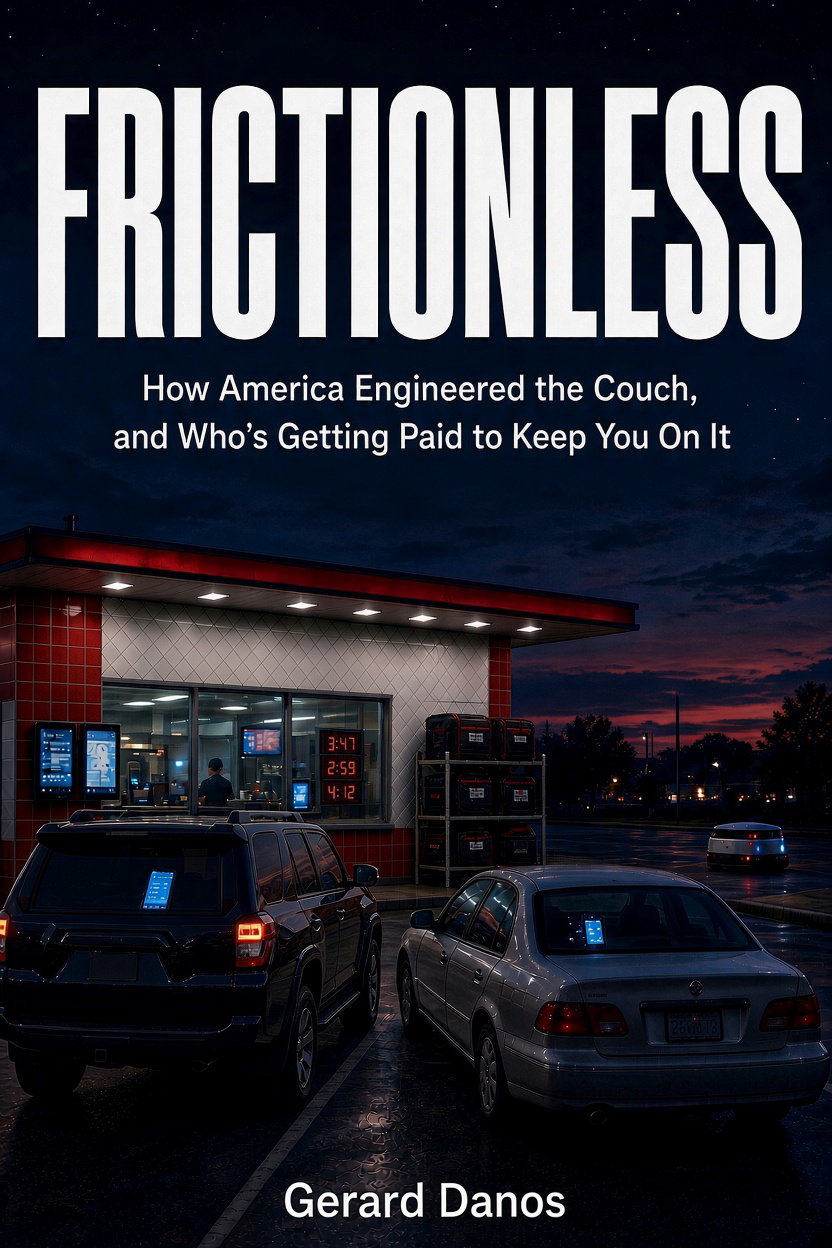
The Book
Frictionless: How America Engineered the Couch, and Who's Getting Paid to Keep You On It
A Freakonomics-meets-Kitchen-Confidential account of the gig delivery economy, written from the front seat of a car doing the actual deliveries — over 2,200 of them, with a perfect completion rate and a 5.0 customer rating. The Friction Tax is the idea at the center of it. This page exists because the idea outgrew the book before the book was even finished.