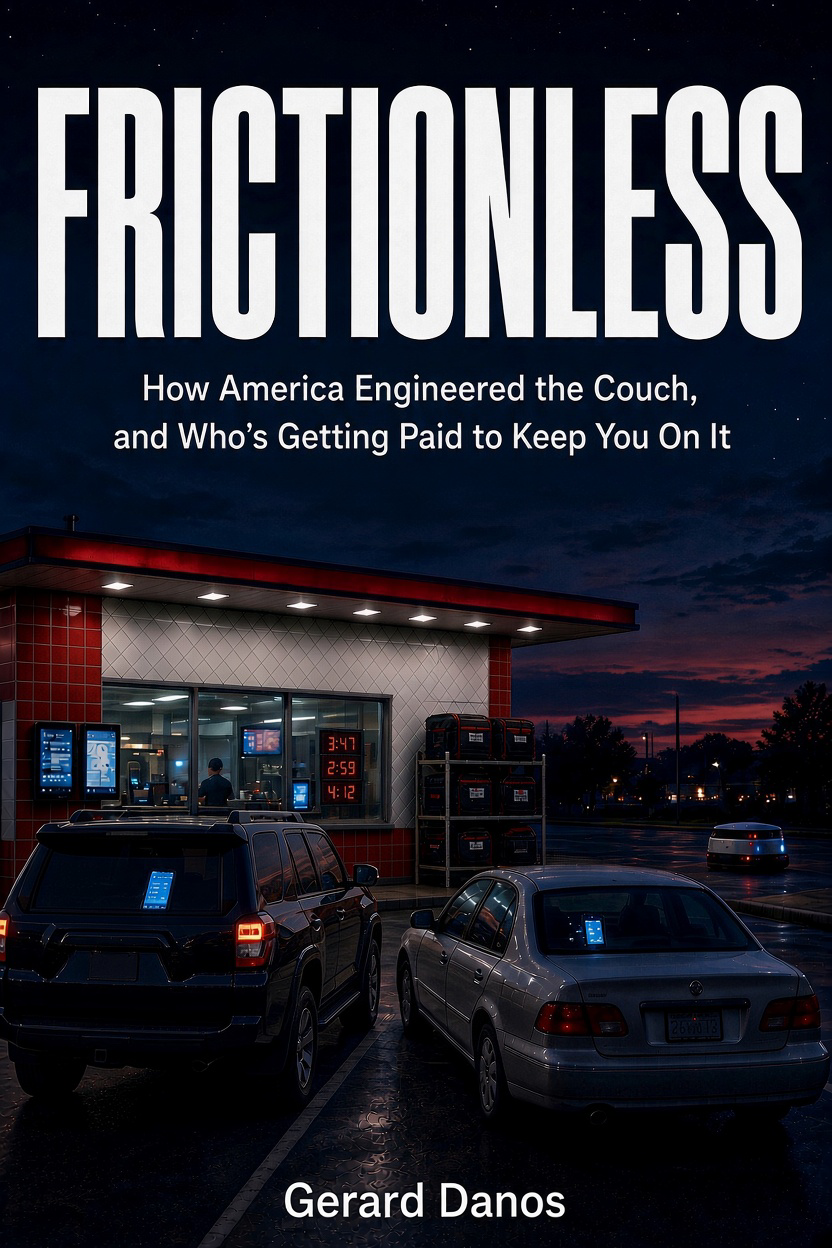
FRICTIONLESS
Friction hasn’t disappeared. It has changed owners.
How America Engineered the Couch—and Who Pays to Keep You on It. A Freakonomics-meets-Kitchen-Confidential account of the hidden cost of convenience, told as dark comedy with receipts. The manuscript is complete: about 49,000 words of narrative nonfiction.
Primary records available upon request. gerard@frictiontax.org
Impulse Decoupling
From Chapter One of Frictionless.
Behavioral economists call it decoupling: separate the pain of paying from the pleasure of buying, and people spend more money. Soman and Gourville, one of them a Harvard Business School professor, wrote a fancy paper on it back in 2001.
The delivery apps didn't just learn that lesson. They ran it into the end zone, spiked the football, hit Justin Jefferson's Griddy, and had the entire tech-stack engineering team line up for a synchronized trust fall on the turf.
They didn't just separate the payment from the burger. They separated the craving from the decision. I call it impulse decoupling.
Every single friction point where your brain used to get a vote got systematically executed: digging out a soggy leather wallet, standing in a fluorescent line next to a coughing stranger, or looking a real-life teenager in the eye while ordering a second 1,200-calorie milkshake at 11:45 PM.
All deleted.
They don't just present an option; they fish for you. The UX designers built the interface like an algorithmic angler dropping live bait from the top of the water column straight into your open checkout box. You're just scrolling, and suddenly a high-margin upsell pop-up slides smoothly down your screen, anchoring itself over your cart before you can hit back. Now make it a McDonald's hot apple pie, dropping from the top of your screen like a fishing lure hitting the water, right into your cart, right below where your thumb is already hovering. That's impulse decoupling in its purest form. It's a precision strike.
The impulse fires, your thumb taps a glowing piece of glass, and your rational mind doesn't even know a crime was committed until a guy in a 4Runner is idling in your driveway.
Depreciation Arbitrage
From Chapter Twelve of Frictionless.
The gig economy relies on a very specific kind of financial math: your willingness to liquidate your automobile one mile at a time without realizing you're doing it. I call it depreciation arbitrage.
When you sign up, the platform plays the role of Eugene Levy in National Lampoon's Vacation, pitching you on the flexibility of turning your personal vehicle into a commercial fleet asset: "You think you hate it now, but wait 'til you drive it."
Thirty thousand miles later—after midnight curb-strikes, sudden u-turns, and idling in drive-thrus—your sedan looks less like personal transportation and more like Clark Griswold limping that crushed, smoking Family Truckster into a backwoods desert garage. It's missing three hubcaps, the bumper is zip-tied to the frame, and a cloud of burnt transmission fluid follows you down the alley.
That's when the algorithm reveals its true identity as the desert mechanic. When you pull your earnings out at the end of the night and ask what the shift cost you in vehicle wear, the system looks you dead in the eye, brandishes the maintenance bill, and gives the exact same line:
"How much you got? All of it, boy."